Cold Brew Liqueur | Loveday x Origin
£16.00
£16.00
£25.00
£39.95
£6.50
£13.00
£8.00
Speciality Coffee, Ready to Serve
Published, Jan 12, 2023

Yet despite how little is spoken – or known – about this fiercely resilient nation, there’s plenty to be said about coffee from Timor-Leste. From the introduction of coffee during occupation, to a varietal that is shaping the country’s future, here we explore the potential of coffee, and why we look forward to showcasing plenty more cups from Timor-Leste.
Timor-Leste (previously known, under rule, as East Timor) has had anything but a quiet history. The country has endured numerous invasions, conflicts, and a long fight for freedom. The Portuguese arrived in 1520, followed by the Spanish in 1522; the Dutch took possession of the western portion of the island in 1613; the British governed the island between 1812-15; and the Japanese occupied during WWII. East Timor remained in Portuguese possession until 1975, when one of the major political parties gained control of most of the territory and declared independence as the Democratic Republic of East Timor. Indonesian forces invaded and occupied the country, and in 1976 Indonesia declared it to be an integral part of the country, as the province of East Timor. For the next 20 years, tens of thousands of people died trying to resist occupation.
Slowly, voices began to be heard, and in 1999 a referendum took place, resulting in the Indonesian parliament rescinding their annexation of the territory: East Timor was returned to its pre-annexation status of independence but under UN supervision as a no-self-governing territory, while violence from anti-independence militants continued. Finally, in 2002, East Timor gained full status as a sovereign state – the first new sovereign state of the 21st century – becoming Timor Leste.

Coffee came to Timor Leste under occupation by the Portuguese, but little was done with the crop. Under Indonesian control in the 1970s, coffee was produced by landowners, but many plantations were abandoned during occupation. Today, coffee is the country’s chief export, and the future is looking promising.
Located on the eastern half of Timor (the western half of the island is a part of Indonesia), Timor-Leste sits to the east of Papua New Guinea, and above Australia, surrounded by coral reefs teeming with marine life.
The famous Cristo Rei de Dili statue sits on a hilltop east of the city of Dili, Timor-Leste's capital and main port. Timor-Leste is an agrarian country with its main agriculture linked to rice, soybeans, sweet potatoes, mangoes, bananas, vanilla and, of course, coffee. 25 percent of all households in the country grow their own coffee.
Despite a short rainy season, arid highlands, struggles with humidity, and low nutrients in soil, coffee grows well in the tropical climate of Timor-Leste under plentiful shade trees, and most is grown organically.

The Timor hybrid is of deserved importance in the global coffee industry, positively shaping the future of coffee production for many places around the world where common diseases, such as coffee leaf rust, can devastate harvest prospects for many farmers.
The varietal, first discovered in the country in the 1920s, is a cross between the Coffea Arabica and the Coffea Canephora (Robusta) plants: it is almost impossible for these two plants to mate naturally; Robusta is a diploid species that needs cross-pollination, while Arabica is a tetraploid that is self-pollinating. The Robusta plant, as the name implies, is more robust and resilient to disease; thanks to this rare natural occurrence, at least five disease resistant genes in the Timor hybrid were inherited from Robusta.
Farmers began growing the Timor hybrid – also known as Hibrido de Timor (HDT), and Tim Tim (Timor Timur) – in the 1940s. In the 50s and 60s, Timor hybrid seeds made their way to other Indonesian islands and then to research institutes worldwide, where breeders began crossing them with other Arabica coffee plants, looking to harness the genetic resources from the plant, with the potential to find incredible flavours and strong resilience – such as in resulting varietals like Sarchmor and Catimor.
The Timor hybrid often presents a full to medium, smooth and creamy body, and a vibrant yet low acidity in coffee from Timor-Leste. Brown sugar and chocolate are common in tasting notes, along with a gentle, pleasing earthiness.
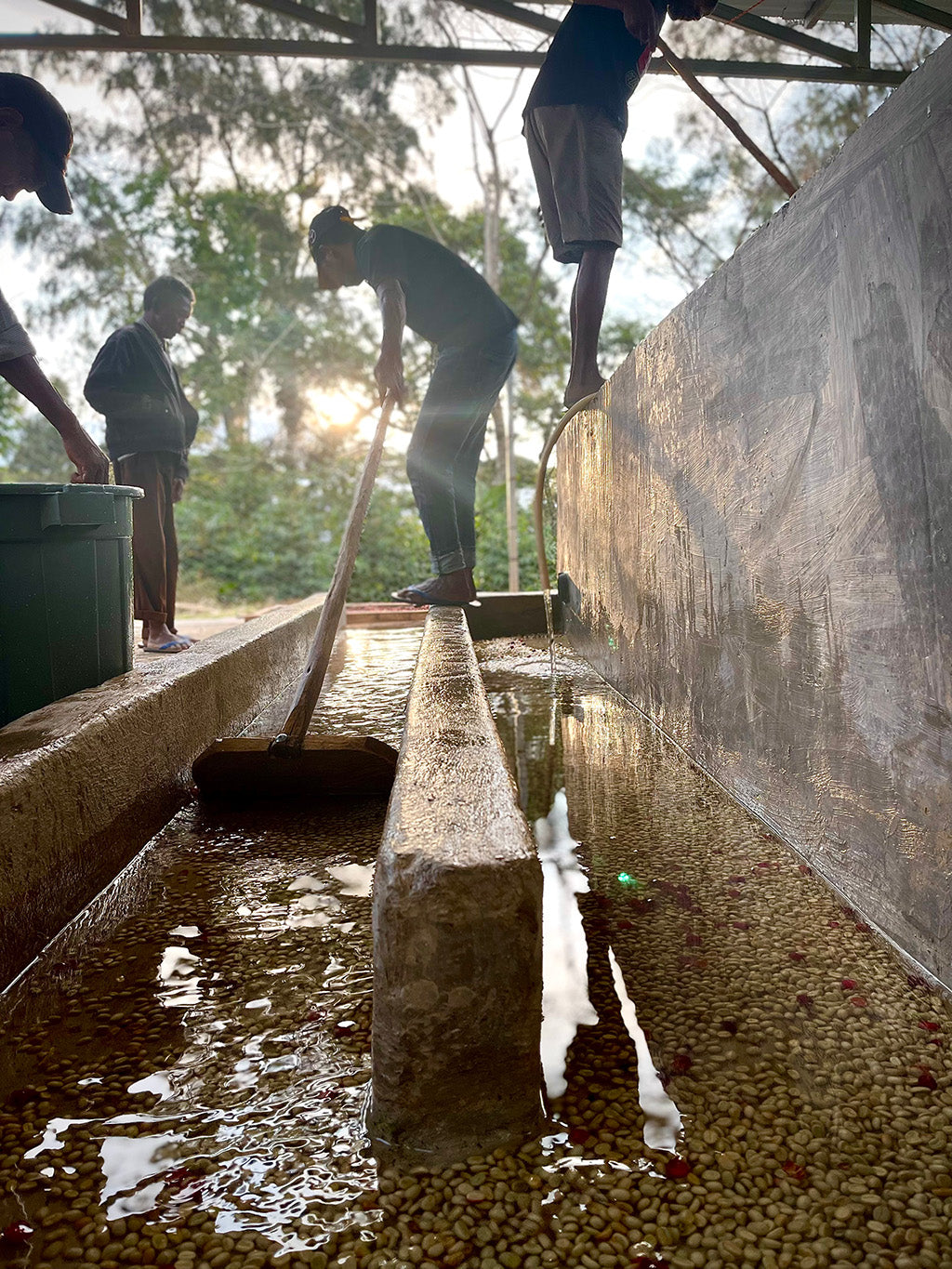

Traditionally, coffee harvested in Timor-Leste is then wet-processed—differing from neighbouring Indonesia, where producing regions commonly wet-hull their coffee. In both instances, coffee cherries are picked, pulped of skin, fermented, and washed. The difference is that wet hulled are removed from parchment when still at high moisture (25 percent or more), then dried on patios. Wet processed coffees are allowed to dry slowly in the parchment, then rested in warehouses to stabilise, and then hulled at 10-11% moisture.
It feels like Timor-Leste's journey into speciality coffee is only just really beginning, with the people working hard to tell their own story. While transport infrastructure, language, and training still provide hurdles, we’re delighted to be able to work with trusted exporters and importers, providing us with a bridge in which we can cross, connecting Timor-Leste's coffee with the world, gaining the recognition it – and the people – deserves.
--
View our current coffee portfolio and discover our latest Timor-Leste release - here